


Pourover Coffee Brewer: Craft Your Perfect Cup
A pourover coffee brewer is a manual brewing device that allows you to control every variable in your coffee extraction, from water temperature to pour rate, resulting in a clean, nuanced cup that highlights your coffee's unique flavor notes. Unlike automatic drip machines, this hands-on method transforms your morning brew into a meditative ritual, one that invites you to slow down and truly taste what's in your cup.
In the Grove, where mornings arrive with soft light filtering through leaves and steam rising in gentle curls, coffee is never rushed. It's a practice. The pourover coffee brewer embodies this philosophy perfectly, asking you to be present as water spirals over grounds, releasing aromas that fill your kitchen with the promise of something extraordinary. This isn't about convenience; it's about connection to the craft, to the beans, and to the quiet moment before the day begins.
The Ancient Art Meets Modern Ritual
The pourover method traces its roots to early 20th century Germany, when Melitta Bentz invented the first paper coffee filter in 1908. She was tired of bitter, over-extracted coffee and ground residue in her cup. Her innovation sparked a revolution in coffee clarity and taste.
Fast forward to 2026, and the pourover coffee brewer has evolved into dozens of designs, each with its own philosophy. Some brewers feature flat bottoms, others conical shapes. The differences aren't just aesthetic; they fundamentally change how water interacts with coffee grounds, affecting extraction time, turbulence, and ultimately, flavor.
Why Manual Brewing Matters
When you choose a pourover coffee brewer, you're choosing control. Temperature precision, grind consistency, and pour technique all become variables you can adjust to match your beans and your taste preferences.
The beauty lies in the repeatability. Once you dial in your perfect recipe, you can recreate that exact cup every single morning. But you can also experiment, tweaking one variable at a time to explore how your coffee responds.
Choosing Your Pourover Coffee Brewer
Walk into any specialty coffee shop in 2026, and you'll encounter a constellation of pourover options. Each design tells a different story about what its creators value in coffee extraction.
| Brewer Type | Material | Capacity | Best For |
|---|---|---|---|
| Cone-shaped | Ceramic, glass, plastic | 1-4 cups | Clean, bright flavors |
| Flat-bottom | Stainless steel, ceramic | 1-3 cups | Even extraction, fuller body |
| Wave-style | Glass, ceramic | 1-2 cups | Consistent results, forgiving technique |
| Immersion-pour hybrid | Glass, plastic | 1-6 cups | Rich body with clarity |
The cone-shaped brewer remains the most popular choice, celebrated for its ability to produce a cup with exceptional clarity. Water flows through in a predictable pattern, and the single drainage hole at the bottom allows you to control flow rate with your pour speed.
Flat-bottom brewers distribute water more evenly across the coffee bed. This design philosophy prioritizes uniformity in extraction, which can be particularly forgiving if your grind size isn't perfectly consistent. Learn more about optimal pourover techniques to match your chosen brewer.
Material Matters
Your pourover coffee brewer's material affects heat retention and durability. Ceramic brewers hold temperature beautifully but require preheating. Glass versions let you watch the brew process unfold, a visual poetry that adds to the ritual. Plastic options are lightweight and nearly indestructible, perfect for coffee for camping adventures.
Metal brewers, typically stainless steel, combine durability with excellent heat retention. They're investments that can last decades with proper care.
The Five-Sense Experience
Touch comes first. You feel the weight of the kettle in your hand, the smooth ceramic of your brewer as you set it atop your favorite mug. There's a tactile satisfaction in grinding beans, feeling their texture shift from whole to grounds between your fingers.
Sight follows. Watch as water first hits the coffee, blooming upward in a gentle dome as carbon dioxide escapes. The grounds darken, releasing tiny bubbles. Your pour creates patterns, spirals that spread outward from center to edge, saturating every particle evenly.
Sound enters subtly. The kettle's whisper as steam escapes. The quiet patter of water meeting grounds. The gentle drip, drip, drip as brewed coffee falls into your waiting vessel.
Aroma arrives in waves. First, the dry fragrance of fresh grounds. Then, as hot water releases volatile compounds, the room fills with notes specific to your beans. Perhaps it's chocolate and hazelnut, or bright citrus and floral jasmine. Specialty coffee in packs can capture these complex profiles in convenient single-serve formats.
Taste completes the circle. That first sip, when temperature has dropped just enough to appreciate nuance. Your pourover coffee brewer has extracted sweetness, acidity, and body in careful balance. Each subsequent sip reveals new dimensions as the coffee cools and evolves.
Mastering the Pour
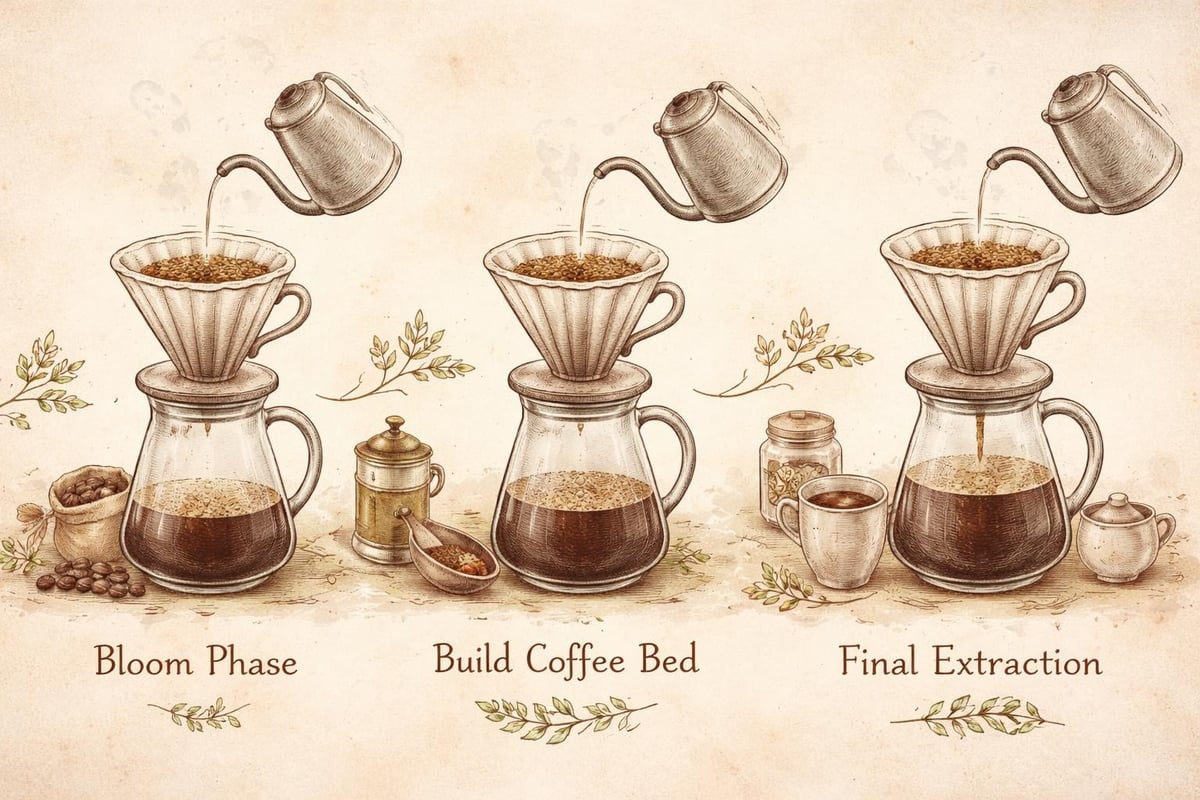
The pourover coffee brewer demands technique, but that's precisely where its magic lives. Start with the bloom: pour roughly twice the weight of your coffee grounds in water, just off boil. Let it sit for 30 to 45 seconds.
This bloom phase is crucial. It allows trapped carbon dioxide to escape, preventing channeling and ensuring even extraction in subsequent pours. You'll see the coffee bed rise and bubble, a living process unfolding before you.
The Pour Pattern
After blooming, pour in slow, controlled spirals from center outward, never hitting the filter directly. This technique ensures all grounds receive equal saturation. Detailed pourover brewing guides offer specific timing and volume recommendations.
- First pour: Bloom with 60g water for 30g coffee
- Second pour: Add 120g water in spiral pattern
- Third pour: Final 120g water to reach total brew weight
- Total time: Aim for 2.5 to 3.5 minutes depending on recipe
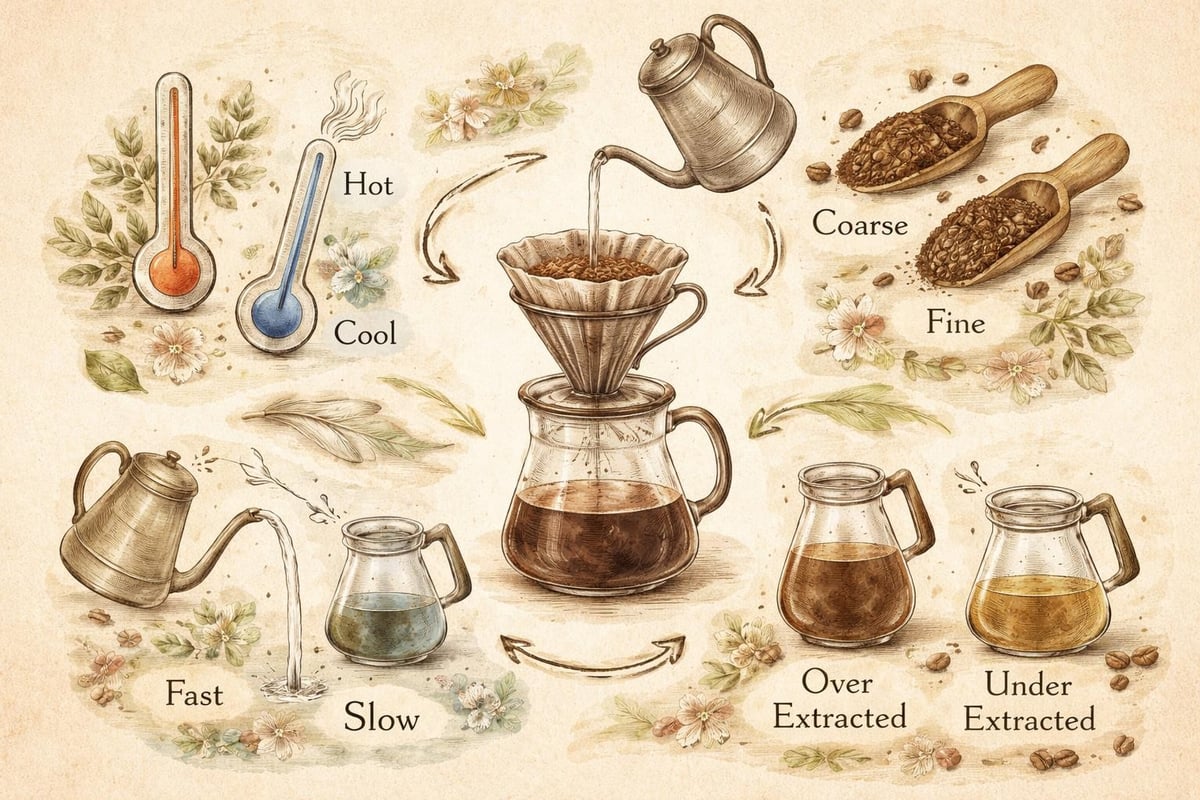
Your pour rate controls extraction speed. Pour too fast, and water finds the path of least resistance, under-extracting some grounds while over-extracting others. Pour too slowly, and you risk over-extraction, pulling bitter compounds you don't want.
Variables That Transform Your Cup
Water temperature sits at the heart of extraction chemistry. Most pourover coffee brewer enthusiasts target 195 to 205 degrees Fahrenheit. Lighter roasts often benefit from hotter water to fully extract their delicate flavors, while darker roasts can taste harsh if water's too hot.
Grind size operates on a spectrum from fine to coarse. For pourover, you want something resembling granulated sugar, medium-fine with some variation in particle size. This creates a coffee bed with enough resistance to slow water flow, allowing proper extraction time.
Coffee-to-water ratio provides your recipe's foundation. The standard starting point is 1:15 or 1:16 (coffee to water by weight). That's roughly 30 grams of coffee to 450-480 grams of water. Understanding brewing ratios helps you dial in your preferred strength.
| Variable | Range | Effect on Flavor |
|---|---|---|
| Temperature | 195-205°F | Higher = more extraction, brightness |
| Grind Size | Medium-fine | Finer = slower flow, more extraction |
| Ratio | 1:14 to 1:17 | Lower = stronger, more intense |
| Time | 2:30-4:00 | Longer = more extraction, potential bitterness |
The Grove's Approach to Pourover
In the Grove, coffee brewing aligns with natural rhythms. Morning light arrives slowly. So does your coffee. The pourover coffee brewer becomes an anchor point, a few minutes carved from the rush where nothing exists except water, grounds, and intention.
This philosophy extends beyond method to bean selection. Origin matters. Processing method matters. Roast level matters. When you control the brewing process this precisely, these details become not just noticeable but celebrated.
Consider a naturally processed Ethiopian coffee through your pourover coffee brewer. The method's clarity lets berry notes shine without muddiness. Or a washed Colombian, where balanced sweetness and bright acidity can express themselves fully.
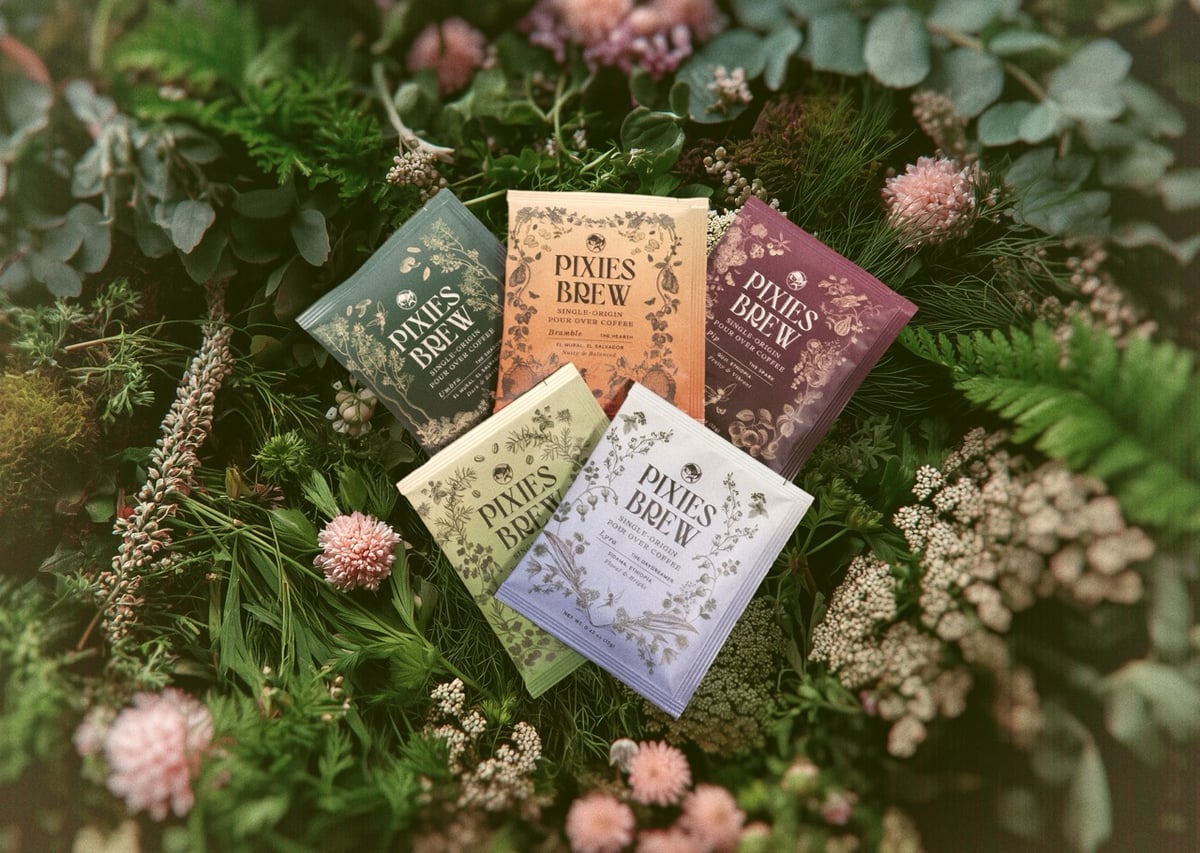
Pixies Brew captures this intentional approach in single-serve pourover sachets, where specialty-grade beans are precisely portioned and ready to brew. Each packet delivers the craft of pourover without requiring a full setup, perfect for those mornings when magic needs to fit into a tighter timeline.
Seasonal Variations
Your pourover coffee brewer can showcase seasonal coffee releases beautifully. Fall collections often feature coffees with warming spice notes and deeper body. Spring might bring brighter, more floral options. The clarity of pourover extraction lets you taste these seasonal shifts in real time.
Common Mistakes and How to Avoid Them
Uneven pouring creates channels in the coffee bed where water rushes through, under-extracting most grounds while over-extracting others. Solution: Practice consistent spiral pours, maintaining steady flow rate.
Forgetting to preheat your pourover coffee brewer and mug results in temperature loss during brewing. Heat retention affects extraction consistency. Always run hot water through your equipment first.
Inconsistent grind creates unpredictable extraction. Invest in a quality burr grinder. Blade grinders produce too many fines and boulders, making it nearly impossible to dial in your recipe.
Ignoring water quality sabotages even perfect technique. Coffee is 98% water. Use filtered water with balanced mineral content. Too soft, and your coffee tastes flat. Too hard, and minerals create scaling and off-flavors.
Pouring too close to the filter causes bypass, where water runs down the sides without extracting coffee. Keep your pour focused on the coffee bed itself, especially during the center spiral.
Advanced Techniques for 2026
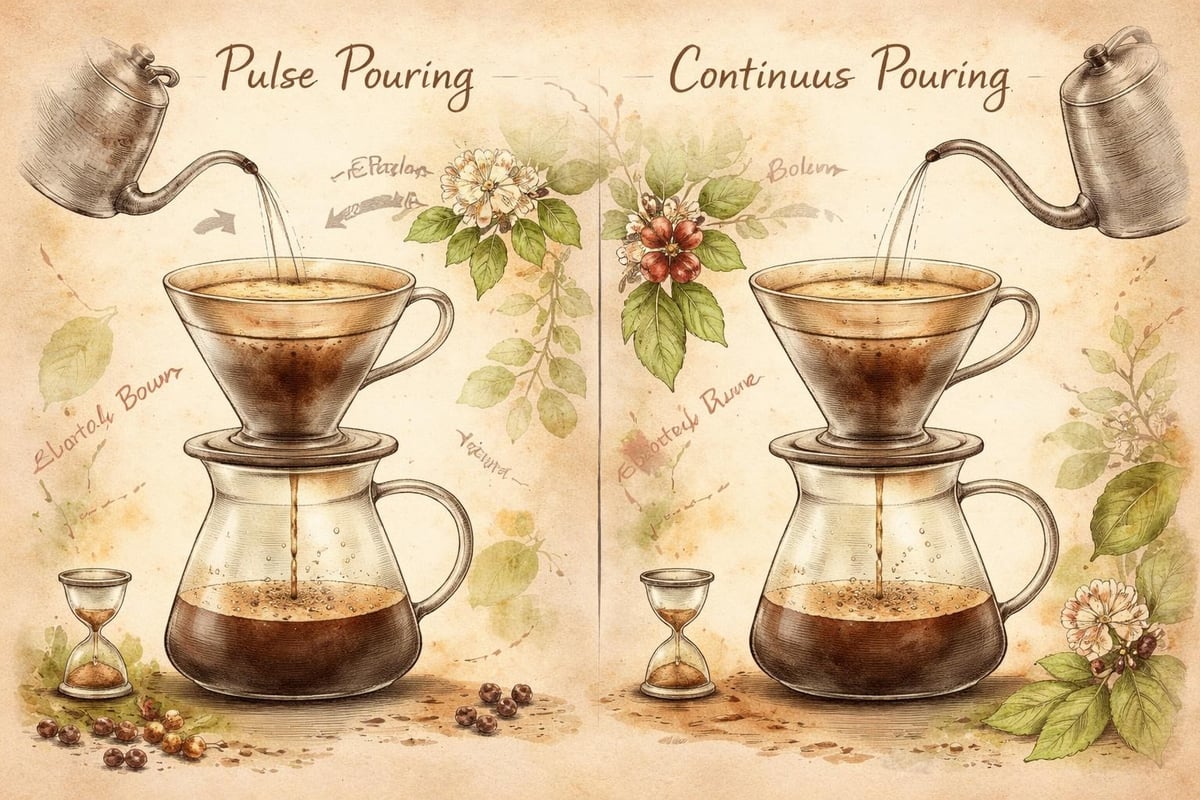
Pulse pouring has gained popularity among specialty coffee enthusiasts. Instead of continuous pouring, you add water in distinct pulses, allowing the bed to drain slightly between additions. This technique offers additional control over extraction and can highlight different flavor notes.
Temperature staging involves starting with slightly cooler water for the bloom, then increasing temperature for subsequent pours. This approach can reduce astringency while maximizing sweetness and complexity.
Some brewers experiment with agitation, gently stirring the coffee bed during bloom or between pours. This ensures even saturation and can increase body. However, it requires a delicate touch to avoid over-extraction.
Comparing different pourover brewers reveals how design variations encourage different techniques. Some brewers feature built-in turbulence from ribbed walls. Others prioritize laminar flow for gentleness.
Building Your Daily Ritual
Your pourover coffee brewer ritual begins the night before. Set out your equipment. Check your bean supply. This small act of preparation transforms morning brewing from chore to ceremony.
Morning arrives. Boil water. Weigh beans. The grinder's hum becomes your wake-up call, more gentle than any alarm. Smell the grounds. Set your brewer. The sequence becomes muscle memory, but never mindless.
Creating Space
The three minutes your pourover coffee brewer needs become three minutes you give yourself. No phone. No email. Just the present moment, the spiral pour, the rising steam. This isn't wasted time; it's invested time, setting your day's tone.
Some mornings call for bright, citrus-forward coffees that energize and awaken. Others need comfort, chocolatey warmth, something familiar. Your pourover coffee brewer can deliver both, switching between beans and ratios to match your mood.
The Science Behind the Magic
Extraction happens when water dissolves soluble compounds from coffee grounds. Ideal extraction hovers between 18% and 22% of the bean's total mass. Under-extracted coffee tastes sour, grassy, and underdeveloped. Over-extracted coffee becomes bitter, astringent, and hollow.
Your pourover coffee brewer's design influences turbulence in the coffee bed. More turbulence generally means faster, more thorough extraction. Less turbulence can produce delicate, tea-like qualities in the cup.
Contact time between water and coffee determines how much extraction occurs. Finer grinds slow water flow, increasing contact time. Coarser grinds allow faster drainage, reducing contact time. Your target is the sweet spot where desirable compounds extract fully while bitter compounds remain in the grounds.
FAQ
How is a pourover coffee brewer different from a drip machine?
A pourover coffee brewer gives you manual control over every variable: water temperature, pour rate, grind size, and timing. Drip machines automate these factors, which can produce consistent but less nuanced results. The pourover method also typically uses a thicker filter and produces a cleaner cup with more pronounced clarity.
What grind size works best for pourover brewing?
Medium-fine grind works best for most pourover coffee brewer designs, resembling granulated sugar in texture. The exact setting depends on your specific brewer and recipe, but you want enough resistance to slow water flow while avoiding clogging. Experiment in small increments to find your ideal setting.
How much coffee should I use in a pourover coffee brewer?
Start with a 1:15 or 1:16 ratio of coffee to water by weight. For a standard 12-ounce cup (about 350ml), use 22-23 grams of coffee and 350-370 grams of water. Adjust based on taste preference: more coffee for stronger brew, less for lighter extraction.
Can I use pre-ground coffee with a pourover coffee brewer?
Yes, though freshly ground coffee produces superior results. Pre-ground coffee loses volatile aromatics quickly after grinding. If using pre-ground, store it in an airtight container away from light and heat, and use within a week. Look for coffee ground specifically for pourover or drip methods.
How do I clean my pourover coffee brewer?
Rinse your pourover coffee brewer with hot water after each use. Once weekly, wash with mild dish soap and warm water, paying attention to any buildup in ridges or drainage holes. Avoid abrasive scrubbers on ceramic or glass brewers. Some plastic models are dishwasher safe.
The Joy of Daily Discovery
Every morning with your pourover coffee brewer offers new possibilities. Perhaps today you'll try that luxury coffee brand you've been saving for a special occasion. Or maybe you'll perfect the recipe you've been refining all week.
The pourover method rewards attention and punishes distraction. But that's its gift. In a world optimized for multitasking and efficiency, your pourover coffee brewer demands you be here, now, focused on this one beautiful task. The coffee that results tastes better not just because of superior extraction, but because you were fully present while making it.
Whether you choose a classic ceramic cone, an innovative flat-bottom design, or the convenience of pre-portioned specialty sachets, the pourover philosophy remains constant: slow down, pay attention, taste deeply. Let your morning coffee be more than caffeine delivery. Let it be a moment of pause, reflection, and genuine pleasure.
The pourover coffee brewer transforms your daily coffee from routine to ritual, from beverage to experience. When you're ready to bring this intentional brewing philosophy into your mornings without the full equipment investment, Pixies Brew offers specialty-grade pourover sachets that honor the craft while respecting your time. Each delicate packet delivers the clarity and nuance of manual brewing, inviting you to pause, pour, and discover what truly exceptional coffee can be.
